
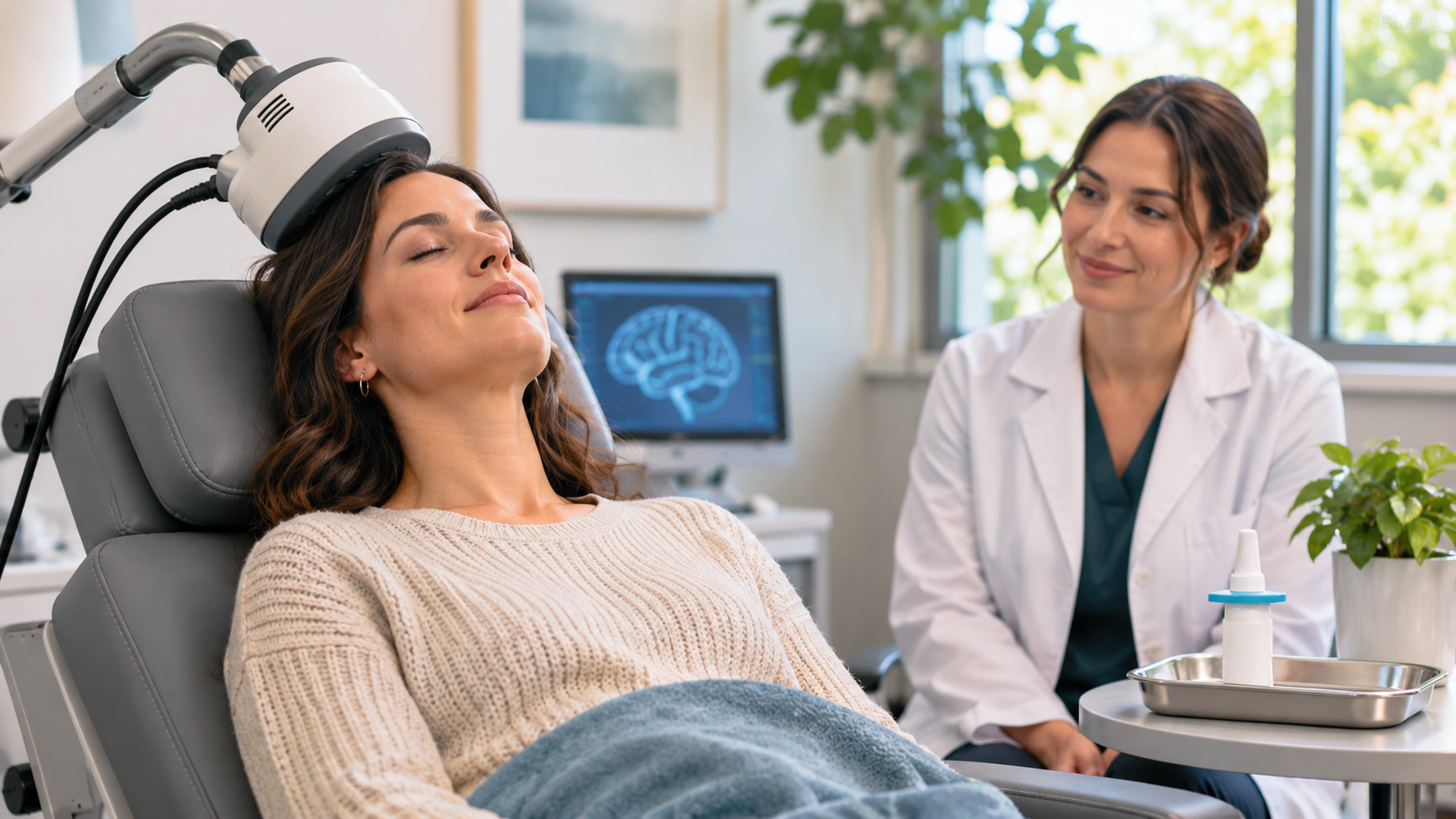
TMS and Spravato both help adults with treatment-resistant depression, but they work in different ways. TMS therapy uses magnetic pulses in sessions of about 19 minutes, five days per week, while Spravato is an esketamine nasal spray given under at least two hours of monitoring. No large head-to-head trial has named a winner, so the right choice depends on your health history, schedule, and preferences.
What Is the Difference Between TMS Therapy and Spravato?
TMS and Spravato differ in how they reach the brain, how often you visit, and what you feel during treatment. Transcranial magnetic stimulation (TMS) is a noninvasive procedure that places a magnetic coil against the scalp to stimulate the left prefrontal cortex, an area linked to mood regulation. NeuroStar Advanced Therapy is FDA-cleared for adults with major depressive disorder who have not benefited from antidepressants, and you stay awake and alert the whole time. Spravato (esketamine) is a prescription nasal spray that the FDA approved in 2019 for treatment-resistant depression. It acts on the glutamate system, which is different from how most oral antidepressants work. In January 2025, the FDA expanded its label so it can be used with or without an oral antidepressant. Because Spravato can cause sedation and dissociation, it is only given in REMS-certified settings with monitoring after each dose.
How Effective Are TMS and Spravato for Treatment-Resistant Depression?
Both treatments have published evidence, but the numbers come from different studies and cannot be compared directly. In a 2012 naturalistic study of 307 patients treated at 42 U.S. TMS practices, Carpenter and colleagues reported that 58% responded and 37% reached remission on a clinician-rated scale. In the 2019 TRANSFORM-2 trial, adults who used esketamine with a new oral antidepressant improved more on the MADRS depression scale at day 28 than those who took an antidepressant with a placebo spray. Analyses of that trial reported response in 69.3% versus 52.0% and remission in 52.5% versus 31.0%. Researchers have not completed a large randomized trial comparing TMS and Spravato head to head, and small retrospective and pooled analyses have shown mixed results. Results vary from person to person, so your prescriber will weigh your history rather than a single statistic.
Which Works Faster, TMS or Spravato?
Spravato often shows effects sooner, while TMS builds gradually over a multi-week course. In the placebo-controlled trial that supported the January 2025 monotherapy approval, Spravato improved depression scores compared with placebo as early as 24 hours after a dose, and 22.5% of people taking Spravato reached remission at week 4 versus 7.6% taking placebo. That speed can matter for adults whose depression is severe. TMS works differently. A standard NeuroStar course is 36 sessions given five days per week over about 6 to 9 weeks, and many people notice changes partway through rather than after the first visit. Faster onset does not automatically mean better long-term results, and some people respond to one treatment but not the other. Your prescriber can help you weigh how urgently you need relief against the time, side effects, and travel each option involves.
What Are the Side Effects of TMS vs. Spravato?
TMS side effects are usually local and short-lived, while Spravato side effects affect the whole body and require supervision. With NeuroStar TMS, the most common side effect is pain or discomfort at or near the treatment site, and the manufacturer reports that it typically fades after the first week. Headache can occur, and seizure is a rare risk at less than 0.1% per patient. Spravato's FDA label lists dissociation, dizziness, nausea, sleepiness, a spinning sensation, numbness, anxiety, lack of energy, increased blood pressure, vomiting, and feeling drunk among its most common reactions. Its boxed warning covers sedation, dissociation, respiratory depression, abuse and misuse, and suicidal thoughts and behaviors, especially in younger people. Neither list is complete, so review the full safety information with your prescriber. The points below summarize practical differences.
• TMS: scalp discomfort and headache are most common, and most people can drive themselves home
• TMS: seizure is rare (under 0.1% per patient), and non-removable metal in or near the head may rule it out
• Spravato: blood pressure is checked before each dose and during at least 2 hours of monitoring
• Spravato: no driving or operating machinery until the next day after restful sleep
• Spravato: you need a ride home after every treatment session
Who Is a Candidate for TMS or Spravato in Massachusetts?
Candidacy for either treatment starts with a confirmed diagnosis of major depressive disorder and a history of antidepressants that have not worked well enough. Spravato is approved for adults 18 and older with treatment-resistant depression, typically meaning an inadequate response to at least two antidepressants. It is also approved, together with an oral antidepressant, for adults with depression who have acute suicidal thoughts or behavior. NeuroStar TMS is FDA-cleared for adults with major depressive disorder who have not responded to antidepressant medication. Some health factors point toward one option over the other. Certain blood vessel conditions, high blood pressure, or a history of substance misuse may make Spravato less suitable, while metal implants in the head may rule out TMS. Insurance plans in Massachusetts often require prior authorization and records of past medication trials for both treatments.
• Adults 18 and older with major depressive disorder
• At least two antidepressant trials that did not bring enough relief
• No non-removable metal in or near the head (for TMS)
• Blood pressure and vascular history reviewed before Spravato
• Ability to attend frequent in-person visits in Randolph
How Do TMS and Spravato Schedules Compare for Patients in Randolph, MA?
The time commitment looks different for each treatment, and both require in-person visits at the Randolph office. A NeuroStar TMS session lasts about 19 minutes, five days per week, for a course of 36 sessions over 6 to 9 weeks. Most people return to work or daily activities right afterward and can drive themselves. Spravato follows a phased schedule: twice weekly during weeks 1 to 4, weekly during weeks 5 to 8, and then weekly or every 2 weeks based on your response. Each Spravato visit includes at least two hours of monitoring, and you will need someone to drive you home. For people commuting from Quincy, Brockton, Stoughton, or Canton, daily TMS visits may be easier if you live or work nearby, while Spravato involves fewer visits that each take longer. Learn more in our guide to TMS for treatment-resistant depression.
How Can Engrace Behavioral Health Help With TMS vs. Spravato in Massachusetts?
Engrace Behavioral Health Services offers both NeuroStar TMS and Spravato in person at 950 North Main St., Suite 204, Randolph, MA 02368, and as a certified Spravato treatment center it follows REMS monitoring requirements. Our psychiatric mental health nurse practitioners review your diagnosis, past medication trials, health history, and goals to help you decide which option, if either, fits your needs. Medication management and follow-up visits are also available by telehealth across Massachusetts, from Boston and Worcester to Cape Cod. We accept most major insurance plans for medication management, TMS, Spravato, and therapy, and no referral is required. For coverage details, see our guide on whether TMS is covered by insurance in Massachusetts. Call (617) 203-2009 to schedule an evaluation. If you are in crisis or thinking about suicide, call or text 988 (Suicide and Crisis Lifeline) or call 911. This article is for general information and is not medical advice.
Frequently Asked Questions About TMS vs. Spravato
Can you do TMS and Spravato at the same time?
Some clinicians use TMS and Spravato together or in sequence, but evidence for combining them is limited and comes mostly from small studies. Whether it makes sense depends on your symptoms, safety factors, insurance approvals, and how you responded to each treatment. Your prescriber would coordinate scheduling and monitoring. Never add or change a treatment without talking to the clinician who manages your care.
Do I have to stop my antidepressant to start TMS or Spravato?
Not necessarily. Many people continue their current antidepressant during TMS, and Spravato is approved with or without an oral antidepressant for treatment-resistant depression. Any change to your medication should be decided with your prescriber, because stopping an antidepressant abruptly can cause discontinuation symptoms or a return of depression. Your plan will spell out what to continue.
Does insurance cover TMS and Spravato?
Many commercial plans and Medicare cover both treatments for adults who meet medical criteria, usually after prior authorization. Plans often ask for records of past antidepressant trials and a confirmed depression diagnosis. Out-of-pocket costs vary by plan and deductible. For estimates, see our guide to Spravato treatment cost in Massachusetts.
Is ketamine the same as Spravato?
No. Spravato contains esketamine, one form of the ketamine molecule, and it is an FDA-approved nasal spray for specific depression indications. It may only be given in REMS-certified settings with monitoring. Intravenous ketamine for depression is used off label and is not FDA-approved for that purpose. The two differ in dosing, regulation, and insurance coverage.
How long do TMS results last?
Many people maintain improvement for months after a successful TMS course, but depression can return, and how long results last varies. Some people benefit from a repeat course if symptoms come back, depending on insurance criteria. Ongoing medication management and therapy can also help protect progress, and your provider will build a follow-up plan with you.
Can I drive after TMS or Spravato?
Most people can drive themselves home after a TMS session because it does not involve sedation. Spravato is different. Its FDA label says not to drive, operate machinery, or do activities that require full alertness until the next day after restful sleep. Plan for a friend, family member, or ride service to take you home after each Spravato visit.